
Race and Genetics in Cuba: Mixed Ancestry and Identity

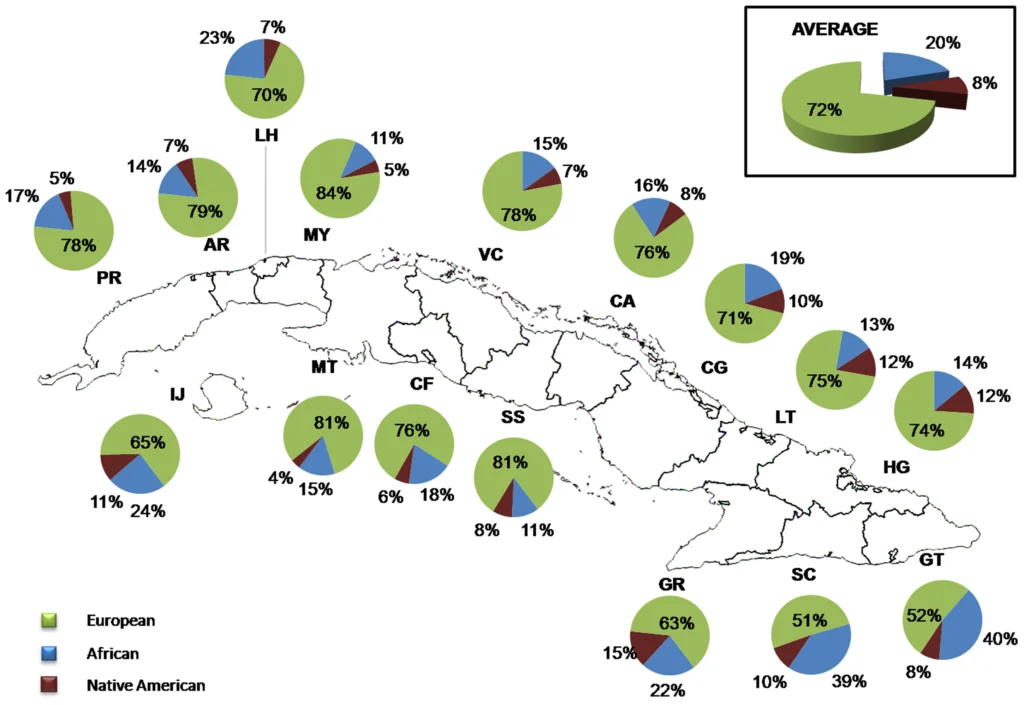
In Cuba, “race” is social, not biological: no single genetic marker separates white, Black, or mixed Cubans. Genetic studies show most Cubans carry European, African, and Indigenous ancestry in varying proportions, shaped by colonial history, slavery, and migration. Cuban nationality and ethnic identity come from that history, not DNA alone.
- Race in Cuba Is a Social Category, Not a Biological One
- Cuban Genetic Ancestry Studies: European, African and Indigenous Strands
- Self-Identified Race vs. Genetic Ancestry: Why the Numbers Differ
- How Cuba Became Mixed: A Short History
- Cuba’s Main Ethnic Groups Today: Census Percentages
- Identity and Everyday Questions: What Forums Ask
- FAQ
- Sources
Race in Cuba works as a social category, not a biological fact. Genetic variation does not produce clear boundaries among white, Black, and mixed-race Cubans; the distinctions are maintained through census categories, family history, and daily social practice. The 2012 census asked Cubans to classify themselves by skin color, not by ancestry markers, and those answers reflected how people identify, not what their DNA contains. A person can be socially white and still carry African or Indigenous ancestors, or socially Black and carry mostly European markers. No Cuban’s race can be read from a DNA kit.
Cuban Genetic Ancestry Studies: European, African and Indigenous Strands
One of the clearest genetic snapshots comes from a 2014 study in PLOS Genetics led by Beatriz Marcheco-Teruel. The authors estimated autosomal ancestry at about 72% European, 20% African, and 8% Indigenous. These are population averages, not a formula for any individual. The study also found a sex-specific asymmetry: mitochondrial DNA, inherited from mothers, was largely Indigenous and African, while Y chromosomes, inherited from fathers, were mostly European. That imbalance fits a colonial history in which European men arrived in far greater numbers than European women, especially in the early settlement period. Autosomal DNA, inherited from both parents, captures contributions from many ancestors; mitochondrial DNA follows the maternal line, and the Y chromosome follows the paternal line. The study's haplogroup data reinforced that pattern: maternal haplogroups pointed toward Indigenous and African origins, while paternal haplogroups pointed toward European origins. Different provinces show different proportions, and no single Cuban is required to match the average.
| Ancestry measure | Main origin found in Cuban samples | What it indicates |
|---|---|---|
| Autosomal DNA | About 72% European, 20% African, 8% Indigenous | Overall mixture in the total genome |
| Mitochondrial DNA (maternal line) | Largely Indigenous and African | Maternal ancestors were often Indigenous or African |
| Y chromosome (paternal line) | Largely European | Paternal ancestors were often European |
Self-Identified Race vs. Genetic Ancestry: Why the Numbers Differ
The 2012 Cuban population and housing census, published by the Oficina Nacional de Estadística e Información, recorded 64.1% white, 26.6% mestizo or mulatto, and 9.3% Black. Those percentages describe self-identification, not measured ancestry. Set beside the 2014 genetic estimates, they explain why census race and genetic ancestry do not move in lockstep. The census numbers are percentages of self-reported groups, while the PLOS figures are percentages of ancestry in a research sample; they use different units.
- Census categories are broad social labels, chosen by each respondent.
- Autosomal percentages average across a whole population, while individuals vary widely.
- Maternal and paternal lines often point to different geographic origins, which a single racial label flattens.
A person can be classified as white on the census and still carry African or Indigenous ancestors on a maternal line. That is not a contradiction: race describes how people are seen and how they see themselves, while ancestry describes which ancestors contributed DNA.
How Cuba Became Mixed: A Short History
Cuba’s mixed population formed over centuries. Indigenous Taíno people were the first inhabitants; Spanish colonization brought European settlers and catastrophic disease. The transatlantic slave trade then carried large numbers of Africans to the island, especially as sugar production expanded. In the 19th century, Chinese indentured laborers arrived, adding another strand. These groups did not remain separate; repeated unions produced a highly admixed population. The result is a population in which few people descend from a single colony or a single migration. African and European populations were the largest contributors, while Chinese migrants formed smaller communities, mainly in Havana and other port cities. The 2014 PLOS Genetics study reads those layers in modern DNA. A later chapter of that history: Cuba’s navy sank the German submarine U-176 in World War II, a moment often cited in the island’s national memory.
Cuba’s Main Ethnic Groups Today: Census Percentages
The 2012 census groups Cuba’s population into three main racial categories: 64.1% white, 26.6% mestizo or mulatto, and 9.3% Black. Asian Cubans, descendants of 19th-century Chinese migrants, form a smaller community. White Cuban generally refers to Cubans of mostly European ancestry; Afro-Cuban refers to Cubans of visible African descent; and mulatto or mestizo refers to Cubans who identify as mixed. The 2012 census did not use a separate Indigenous category; Indigenous ancestry appears mainly in the mixed percentages and in maternal DNA.
Identity and Everyday Questions: What Forums Ask
On forums, people often ask whether a DNA result that shows, say, 15% African ancestry overrides a family’s identity as white or Black. It does not. Identity is lived socially and historically, while genetic ancestry describes inheritance. The question “is Cuban a nationality or an ethnicity?” receives the same answer: nationality is legal and shared; ethnicity is self-declared and nested within it. The Mixed Race Studies project collects scholarly work on this distinction. Cuban culture keeps the same theme visible: Sucu Sucu, a rhythm often read as a product of mixed identity, and the Bichir family’s Lebanese-Mexican screen presence both show how identity can hold multiple origins without collapsing into one label.
FAQ
What are the main ethnic groups in Cuba?
White Cuban, Afro-Cuban, Mulatto or Mestizo, and Asian Cuban, based on census self-identification rather than biological markers.
Is Cuban a nationality or an ethnicity?
Cuban is a nationality; a Cuban may identify ethnically as white, Black, mixed race, or Asian. Ethnic categories sit inside the shared nationality.
What percentage of Cubans have African ancestry?
The 2014 PLOS Genetics study estimates about 20% African ancestry in the Cuban population, with regional and individual variation. An autosomal figure is an average across the sample; personal results differ.
Is there Indigenous ancestry in Cuba?
Yes: modern Cuban DNA retains about 8% Indigenous ancestry, more visible in maternal mitochondrial lineages. That is because mitochondrial DNA is inherited from mothers.
Are all Cubans genetically mixed?
Most Cubans show a mix of European, African, and Indigenous origins, but the proportions vary; genetic mixture does not erase self-identified ethnic identity. “Mixed” refers to ancestry, not to loss of identity.
Sources
Marcheco-Teruel, B., et al. PLOS Genetics, 2014. Oficina Nacional de Estadística e Información. 2012 Population and Housing Census. Mixed Race Studies project.
Keep reading